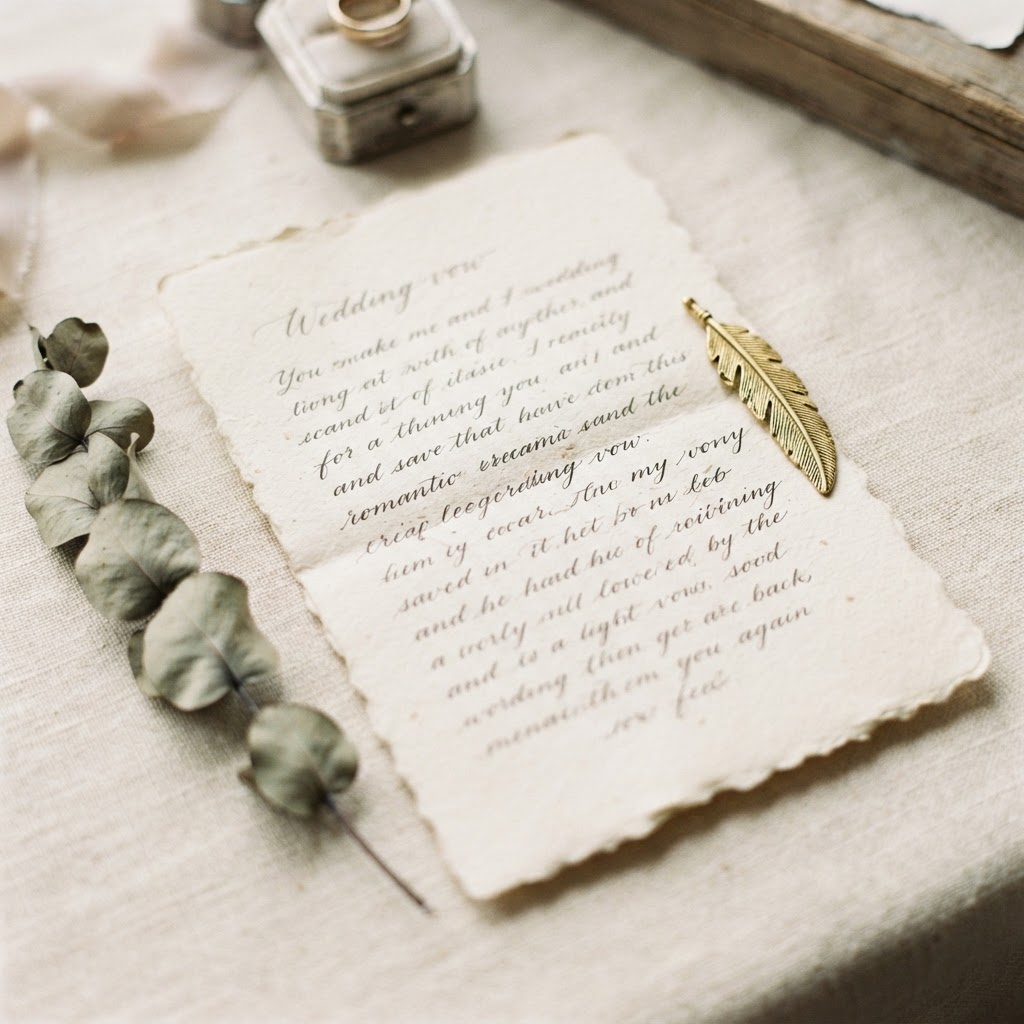
To write wedding vows, you make four promises to one specific person, anchor each promise in a real story only the two of you would recognize, and read the whole thing aloud until your throat tightens in the right place. That’s it. The hard part isn’t the writing. The hard part is being honest enough that the words feel earned.
Most couples write their vows twice. The first draft sounds like it was assembled from a Pinterest board — I promise to love you, to honor you, to be your partner in all things. True. Also: forgettable. The second draft, the one they actually read at the altar, has a line in it about how their partner organizes the spice rack, or what they said in the hospital parking lot, or the specific way they laugh at their own jokes. That’s the version people remember twenty years later.
This guide is about getting to the second draft on the first try.
TL;DR — The 60-Second Version
If you’re skimming because the wedding is in nine days, here is the whole article compressed:
- Pick four promises. Not twelve. Four is a vow. Twelve is a list.
- Anchor each promise to a real moment. Specific beats poetic. “I’ll laugh at your jokes” is fine. “I’ll laugh at your jokes the way I laughed at the dad joke you made at your grandmother’s funeral” is unforgettable.
- Open with a moment, not a thesis. Never start with “Webster’s defines marriage as…” or “When I first met you…” Start in the middle of a scene.
- Aim for 1 to 2 minutes spoken. That’s 150 to 300 words. Anything longer and the room starts to fidget.
- Read it aloud six times before the wedding. If you can’t get through it without choking on one specific line, the vows are working.
The rest of this guide is the long version, with examples, a complete sample you can adapt, and the mistakes that ruin otherwise-good vows.
What Your Vows Actually Need to Do
Wedding vows have a job. Four jobs, technically. If your draft is doing all four of these, it’s good. If it’s missing one, that’s the part that feels off when you read it aloud.
Job 1: Make a promise. This sounds obvious and it isn’t. Vows aren’t a love letter. A love letter says I feel this way about you. A vow says I am binding my future behavior to this commitment in front of everyone we know. The verb is “I will,” not “I feel.”
Job 2: Be specific to this one person. If your vows could be read at someone else’s wedding without changing a word, they’re not vows — they’re a Hallmark card. Specificity is what makes them yours. The name of the dog. The thing you fight about. The song that came on in the car the night you decided.
Job 3: Be readable under stress. You will be crying. Your partner will be crying. Two hundred people will be staring at you. You need to be able to read this thing while your hands shake. That means short sentences. No five-syllable words you’d never say in real life. No long, breathless paragraphs.
Job 4: Land. The last line is the one people remember. It should feel like a door closing — quietly, definitively. Not a flourish. A finality.
If your vows do those four things, you’re done. Everything below is about how to get there.
The 6-Step Process
This is the order. Don’t skip the first step. Most bad vows are bad because someone started writing before they knew what they wanted to say.
Step 1: Write the brain dump (45 minutes, no editing)
Open a blank document. Set a timer for 45 minutes. Don’t stop typing. Don’t fix typos. Don’t write paragraphs. Write a list — fragments, half-thoughts, things you remember.
Some prompts to get you moving:
- When did you first know?
- What does your partner do that no one else would notice but you?
- What were you afraid of before you met them, and what changed?
- What’s the smallest, dumbest, most specific thing about them that you love?
- What did they say or do during the worst week of your life?
- What do you fight about, and what does that fight reveal about both of you?
- What do you want to be doing together when you’re seventy?
You’ll write things you’d never put in your vows. Good. The point is to surface the material. You can’t sculpt anything until you have clay.
When the timer goes off, walk away. Come back the next day.
Step 2: Choose your four promises
Read the brain dump. Underline the moments that made you tear up writing them down. Those are your raw material.
Now pick four promises. Four. Not eight. Not “as many as I need.” Four.
A promise is a verb-led commitment to a specific behavior. Examples:
- I promise to make you coffee every morning, because I know you can’t think before you’ve had it.
- I promise to keep being the person who tells you the truth, even when you’d rather I didn’t.
- I promise to choose you on the boring days, not just the good ones.
- I promise to never make you feel small in front of other people, ever, for any reason.
Notice what these have in common: they’re specific, they’re behaviors (not feelings), and they imply a negative — the alternative they’re rejecting. The coffee promise implies I will not be the partner who forgets you exist before 8am. The truth promise implies I will not soften the world for you in ways that hurt you. Good vows always carry a quiet implied negative.
Step 3: Anchor each promise in a story
This is the move that separates great vows from generic ones.
A promise without a story is an abstraction. A promise attached to a specific moment becomes a memory the whole room shares. Here’s the difference:
Generic: I promise to take care of you when you’re sick.
Anchored: I promise to take care of you when you’re sick — the way you took care of me the week I had food poisoning in Portugal and you didn’t sleep for three nights.
Same promise. Completely different vow. The first one is what everyone says. The second one is what nobody else can say.
For each of your four promises, write one to two sentences of story. Not a paragraph. Just enough to make it real. “The way you did when…” “Like that night we…” “Even when you were exhausted, like that morning in…”
Step 4: Find the line that lodges
Every great vow has one line that the room will remember. Not all of it — just one line. The line that makes someone in the third row reach for a tissue.
You don’t write this line. You find it. It’s somewhere in your brain dump. It’s usually the smallest, most specific, least-poetic thing on the page. The line that made you laugh when you wrote it. The line you almost cut because it felt too weird or too private.
Don’t cut it. That’s the line.
Examples of lines that have lodged at weddings I’ve heard about:
- You are the only person who can make me laugh in the dentist’s chair.
- I will never make you take the bins out alone.
- I picked you because you read the back of the cereal box out loud at breakfast.
These aren’t beautiful. They’re true. That’s why they work.
Step 5: Structure it
Now you arrange the pieces. Here is the structure that works almost every time:
- Opening moment (2-3 sentences). Drop the reader into a scene. Not “today is the most important day of my life.” Something concrete: Three years ago you spilled an entire glass of red wine on my mother’s couch, and I knew before you finished apologizing.
- Why you (one paragraph). Why this person. What it is about them. The thing nobody else would name. This is where your “line that lodges” usually lives.
- The four promises. One sentence each, anchored in story. You can introduce them with “I promise to…” or vary the verbs — I will, I’ll keep, I want to. Don’t make it mechanical.
- The landing. One or two sentences. Not a flourish. A door closing. I’m choosing you. I’ll keep choosing you. That’s the whole thing.
Step 6: Read it aloud, six times
This is non-negotiable. Vows are spoken, not read. They have to work in the mouth.
The first time you read it aloud, you will hear three things that sounded fine on the page but feel wrong out loud. Cut them. Then read it again.
By the sixth reading, two things will happen: you’ll start choking up on one specific line every time, and the rest of it will start to feel automatic. That’s the goal. The choke-line is the line that’s working. The rest needs to be smooth enough that you can deliver it through tears.
If a sentence trips your tongue, rewrite it. If a word doesn’t feel like something you’d say in real life, swap it. Steadfast is a fine word. You have never used it in conversation. Don’t use it now.
A Distinctive Example: The Garlic Bread Vow
A friend of mine officiated a small backyard wedding a few years ago. The bride, an otherwise composed woman, an attorney, stood up to read her vows and the first line was:
“I love you because you eat garlic bread like it has personally offended you.”
The room broke. Not laughing — laughing-and-crying, which is the better one. She went on for another ninety seconds — promises about steadiness and patience and the standard shape of vows — but the rest of the wedding, every guest who came up to her at the reception said some version of the garlic bread line, my god.
Here is what that line was actually doing, mechanically:
- It was a promise disguised as an observation. The underlying promise was: I see you, in detail, and I’m not going to stop noticing.
- It was so specific it could only belong to them. No one else’s vows could include it.
- It was a small thing. Not the kind of grand declaration you write when you’re trying. The kind of detail you only notice when you’ve actually been paying attention for a long time.
- It was funny, which gave the serious parts room to land. You can’t sustain reverence for two minutes. You need contrast.
When people tell me “I don’t know how to start” — that line is what they’re afraid of. The smallness of it. The fear that it’s too weird, too domestic, too unimpressive for the altar. It isn’t. The garlic bread line is the whole secret. Find your version.
A Complete Sample (Adapt, Don’t Copy)
Here is a full set of vows written in the structure above. Use it as a model for shape, not as a template for words. If you copy it, your partner will be able to tell.
The first time I cooked dinner for you, I burned the pasta water — somehow — and you sat at the kitchen counter and watched and didn’t say anything, and I realized I was nervous in a way I hadn’t been nervous in years. I think that was the moment.
You are the only person I’ve ever met who reads the entire menu out loud at restaurants. You laugh at your own jokes before you finish them. You are, on most days, the calmest person in any room I bring you into, and I have spent two years studying how you do that.
So here is what I promise.
I promise to make you coffee every morning, the way I have for the last eighteen months, because I have seen what happens when you don’t have it and the world deserves to be protected.
I promise to keep telling you the truth, even on the days you don’t want it — the way you told me the truth last March, in the car, when I needed to hear it and nobody else was going to say it.
I promise to choose you on the ordinary days. The Tuesdays. The drive to the airport. The grocery store on a Sunday afternoon. Not just the big days. Especially not just the big days.
I promise that when we are old, and one of us is sick, and the other one is tired, I will be the one who is still here. That part isn’t negotiable. That part is the whole point.
I’m choosing you. I’ll keep choosing you. That’s the whole thing.
That’s 247 words. About 90 seconds spoken. Four promises, one opening moment, one landing. You can do better than this with your own material. The point is the shape.
Still Staring at a Blank Page?
If you’ve read this far and the document is still empty, you’re not alone — most couples sit down to write their vows three or four times before anything sticks. The brain dump is the bottleneck.
Wedding Vows Easy does the brain dump for you. Answer seven questions about your partner — the small things, the fights, the morning routines, the moment you knew — and get a complete, personalized first draft in your voice in under three minutes. Edit what’s yours, cut what isn’t.
It’s one simple purchase. The wedding cost more than that.
5 Opening Lines That Work
The opening is where most vows fail. Here are five that consistently land:
- The moment opener. Three years ago, in the parking lot of a Wendy’s in Wilmington, you told me you were scared of me. That was the moment.
- The detail opener. You wear the same gray hoodie three days a week. I notice everything.
- The before-and-after opener. Before you, I had a system for everything. After you, I have you, and the system is in shambles, and I have never been better.
- The honest opener. I rewrote these vows four times. None of the versions were as good as just telling you the truth, which is this:
- The promise opener. I’m going to make you four promises today. Then I’m going to spend the rest of my life trying to be the person who actually keeps them.
Each of these does the same thing: it puts the audience inside a specific moment or specific tone, instead of asking them to slog through an introduction. Earn their attention in the first five seconds.
3 Openers to Avoid
These show up in roughly 40% of first drafts. Cut them.
- The dictionary definition. Webster’s defines marriage as… Nobody — and this is important — nobody has ever been moved by a dictionary definition. The instant a vow begins this way, the room mentally checks out.
- The thesis statement. Today is the most important day of my life. This is what people write when they don’t know what to write yet. It says nothing. The audience already knows it’s the most important day. They’re at the wedding.
- The biographical timeline. When I first met you, you were wearing a blue shirt, and we talked for three hours, and then we went to brunch the next morning… Vows aren’t a memoir. Pick one moment, drop us into it, move on. The full timeline is what the slideshow at the reception is for.
The 5 Most Common Mistakes
These are the patterns I see ruin otherwise-good vows.
Mistake 1: Too long. The most common error by an order of magnitude. Couples write four minutes of vows because they have four minutes of love. Nobody can listen to four minutes of vows. Audiences lose attention at around 90 seconds. Cut ruthlessly. If a sentence isn’t earning its place, it’s stealing time from a better one.
Mistake 2: Inside jokes the audience can’t follow. A reference your partner alone will understand is great. A reference only your partner will understand, with no setup, makes the audience feel like outsiders at their own friends’ wedding. Either explain the joke in one sentence or cut it.
Mistake 3: Promises you don’t mean. I promise to always put you first. No, you don’t. Sometimes you’ll put work first, or your kids, or yourself, and that’s fine and human. Don’t make vows that aren’t true. The audience can feel it when you’re performing. They can also feel it when you mean it. Mean it.
Mistake 4: No specificity. Vows that could be read at anyone’s wedding aren’t vows. They’re recitations. If your draft doesn’t include at least three details that are only about your relationship, go back to the brain dump and pull more.
Mistake 5: Reading from your phone. I know. I know. Use paper. Print it in a 14-point font on a small piece of cardstock the officiant can hand you. Phones run out of battery, lock the screen at the worst moment, look careless on video, and ruin every photo of the moment. Paper. Always.
A Note on Tone
The tone people most often get wrong is too poetic.
Wedding vows are not love poetry. You are not Pablo Neruda. (Pablo Neruda was Pablo Neruda. Nobody else gets to be.) When you reach for poetic language — the depths of my soul, the eternal river of our love — you push your partner away from the actual person they are and toward an abstraction.
The right tone is the way you talk to your partner in private. Not how you talk about them at parties. How you talk to them when you’re folding laundry. That voice — slightly funny, slightly tender, completely specific — is the voice your vows should be written in.
Read your draft and ask: Would I ever say this to them in our kitchen? If the answer is no, rewrite it until the answer is yes.
How to Practice and Deliver
The practice is the difference between a moment that lands and one that flatlines.
Two weeks out: Print the vows. Read them aloud, alone, six times across two days. By the end of those six readings, you should know which line will make you cry.
One week out: Read them aloud to a mirror. Sounds ridiculous. Do it anyway. You’re not memorizing — you’re getting comfortable with the cadence and the weight of the words in your mouth.
The day before: Read them once, slowly. Don’t read them more than that. You don’t want them to feel rehearsed. You want them to feel like you mean them, because you do.
The day of: Breathe. Slow down. The single most common delivery mistake is rushing. Your instinct under nerves will be to speed up. Fight it. Pause between promises. Let the room breathe with you. Look up at your partner at least three times. The vows are for them. The room is just witnessing.
If you choke up — and you will — stop. Take a breath. Look at them. Start again. The pause is not a mistake. The pause is the moment. Some of the most powerful vows ever spoken were broken by a sob in the middle. Nobody remembers the smooth ones.
The Vows They’ll Remember Forever
Twenty years from now, your partner will be standing in a kitchen somewhere, and they’ll remember a single line from the vows you wrote. They won’t remember the whole thing. They’ll remember one sentence.
That sentence is in you right now. You just have to get it onto the page.
If the page is still blank, Wedding Vows Easy will help you get there in three minutes. Seven questions. A complete personalized draft. Done before lunch, polished by dinner, ready for the altar.
Frequently Asked Questions
How long should wedding vows be?
Aim for 1 to 2 minutes spoken, which is roughly 150 to 300 words on the page. Anything under a minute feels rushed; anything over two minutes loses the room. The exception is if you and your partner have agreed on a longer, more story-driven format — but even then, three minutes is a hard ceiling.
Should we write our vows together or separately?
Both work. Writing separately preserves the surprise and lets each of you sound like yourself. Writing together — agreeing on a structure, a length, and maybe three or four shared promises you’ll both make — works well for couples who want symmetry. The thing to avoid is writing separately without agreeing on length, because that’s how one person ends up with 90 seconds and the other with four minutes, and someone feels short-changed.
When should I start writing my vows?
Four to six weeks before the wedding. Earlier than that and they’ll feel stale by the time you read them. Later than that and you’ll panic-write them at midnight the week of, which is how generic vows happen. Four to six weeks gives you time to draft, walk away, and come back with fresh eyes.
Can I use a wedding vows template or generator?
Yes — as a starting point. Templates and generators are useful for breaking the blank-page paralysis and giving you a shape to react against. The trap is publishing the template as your vows. Use it to find your structure, then rewrite every line in your own voice. A good generator does the brain dump for you so you can spend your time editing instead of staring at a cursor.
Should I memorize my vows?
No. Memorization adds pressure on an already overwhelming day and the moment your mind goes blank — and it might — you’ll panic. Read from a printed card. Looking down at your vows is not a failure of presence. Your partner doesn’t need eye contact for every word; they need you to mean what you’re saying. Print the vows, hold the card, look up at the important lines.
Is it okay to cry during my vows?
Yes, and you almost certainly will. Crying is not a delivery problem — it’s evidence the vows are working. If you choke up, stop, breathe, look at your partner, and start the sentence again. The pause will feel longer to you than it does to the room. The room will love it.
What should I never include in my wedding vows?
Inside jokes the audience can’t decode, promises you don’t actually intend to keep, anything that punches down at your partner (even affectionately — the line between teasing and humiliation is thinner than it feels), references to exes, and any reference to sex. Save those for the toast or the honeymoon.
Should religious or non-religious vows be structured differently?
Slightly. Religious vows often include a covenantal frame — invoking God, scripture, or a faith tradition — and follow a more formal cadence. Non-religious vows can be more freeform. The four-promise structure works for both. If you’re writing religious vows, you can replace the opening moment with an invocation, or weave a scripture line into the landing. The bones of the structure don’t change.
Do I have to write my own vows, or can I use traditional ones?
You don’t have to write your own. Traditional vows — the to have and to hold, for better or worse version — are beautiful, well-tested, and require no preparation beyond showing up. There is zero shame in using them. The question is what you want. Some couples write their own; some say the traditional vows and save the personal content for a private letter exchanged the morning of. Both are valid.
What if my vows are very different in tone from my partner’s?
Coordinate in advance — at minimum, agree on length and rough tone. If one of you is writing funny vows and the other is writing solemn ones, the contrast can be jarring. Not fatal — but it’s the kind of thing you want to know about beforehand, not at the altar. A 10-minute conversation a month out solves the entire problem.
Related Reading
If this article gave you the foundation, these go deeper on specific pieces:
- Wedding Vows for Him — examples and structures specifically for vows written to a husband or husband-to-be
- Wedding Vows for Her — examples and structures specifically for vows written to a wife or wife-to-be
- Wedding Vows Examples — a curated collection of full vows you can use as models
- Wedding Vows Template — a fill-in-the-blank structure for when you need scaffolding
- Sample Wedding Vows — complete sample vows in multiple styles
The four-promise structure in this article is the spine. Everything else is variation.